Thursday, September 17th, 6 to 8 pm
The ARTefACTe days, organised by CLUB9, are now in their sixth year. Since 2020, ARTefACTe has been defined as a fluid network of programmes promoting contemporary performance practices that is deployed as a laboratory of new cultural institutionality while creating context in collaboration with the city’s visual arts ecosystem.
ARTefACTe6 will this year premiere at La Capella with a performance by three emerging performance artists from ESTÀRTER 2026. Prior to this, Oscar Abril Ascaso, the founder of the platform, will introduce the contents of this year’s event alongside his team and several of the participating artists, galleries and spaces.
In mechanics, a starter [in Catalan, estàrter] is a device that helps to start up an engine. Taking this as a reference point, the ESTÀRTER programme is an annual initiative by CLUB9 in collaboration with the Concèntric programme to promote emerging performance arts. ESTÀRTER therefore supports visual artists interested in beginning with performance practices by offering them professional mentoring, an exhibition framework and a showcase for their work. This second ESTÀRTER edition in La Capella presents the actions of three new emerging performance artists from our region: Hina Vagina, Ainhoa Sayol and Gessamí Olesa. ESTÀRTER is part of the ARTefACTe network of contemporary performance arts exhibition programmes.
Hina Vagina
Blanc trencat (Off-White)
Hina Vagina (Palau-solità i Plegamans, 1994) is the artistic name of Judit Chulià Orduña, a hybrid artist who expresses her practice from the idea of the body as a space of resistance, erosion and transformation. Her work is set within an expanded field that encompasses painting, performance, installation and video, through which she examines the tensions between intimacy and exposure, job insecurity and structural exhaustion, as well as the ways these dynamics are inscribed on contemporary bodies.
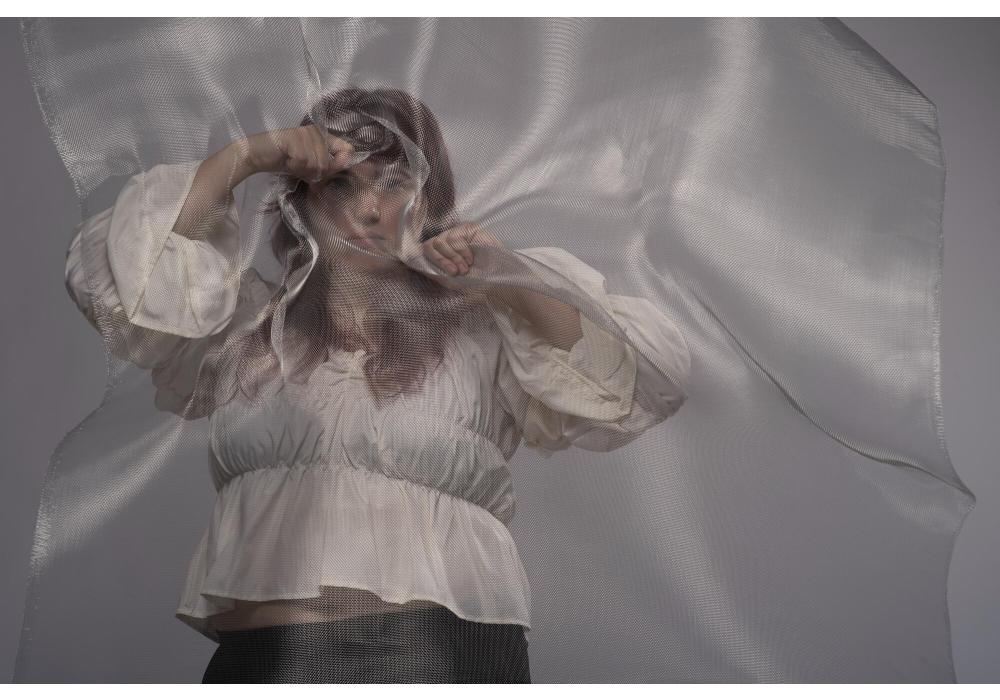
The action Blanc trencat involves removing a mask from the body, freeing it from a weight with chisel and hammer. As this layer disappears, the body appears, the skin appears, the self appears. It is as if we were constructing a sculpture in reverse: from the inside out, from the outside in. As if we were inside a birthday cake and the body were emerging from within. It is also akin to being trapped inside a tunnel from which we finally manage to emerge. It is a simultaneously harsh yet fragile border.
Gessamí Olesa
La terra porta el compàs (The Earth Carries the Compass)
The artistic practice of Gessamí Olesa (Alcanar, 1993) explores the connections between the body, territory, memory and archives through hybrid languages such as installation, audiovisual works, performance, writing and poetry. The Terres de l’Ebre region occupies a central place in her research as a realm of tension between memory, rurality, disappearance, rootedness and transformation. She is interested in action as a form of embodied thought, a place where that which cannot be fully explained appears as gesture, friction and presence.
La terra porta el compàs is structured as a performative investigation into memory, heritage and their forms of bodily inscription. Based on the relationships between body, matter and voice, the project delves into forms of transmission that overflow. The proposal is therefore shaped as a sensitive device that connects intimate experience with shared memory.
Ainhoa Sayol
La meva caixa i castigada al racó (My Box and Corner Punishment)
Ainhoa Sayol’s artistic research uses the fold as a point at which continuous expansion is modified and hence transformed into a new place, a new point of reference. It is through contact with itself that matter is given depth in this change in the homogeneous surface. From this, the artist conceives of her practice as a fold: an encounter between territory (the external) and body (the innermost).
La meva caixa i castigada al racó is a performance that explores the corner as a place of protection, yet also uncertainty. A mechanism for self-knowledge of architectural space and one’s own body is found by changing the direction of the body and accompanying this with drawing as a recording tool. With one’s back against the wall, the corner becomes a refuge: a semi-box, part door, part wall. Although it is transformed into a space of punishment and vulnerability by facing the wall.