Deseo... notes from the itinerary
First Deseo, 26 April 2000, Barcelona.
Deseo*: first person singular of the present indicative of the verb desear.
Deseo no. 1, «llegar a la Universidad» [...] Deseo no. 4, «recitare en un grande teatro» [...] Deseo no. 15, «nadar con los delfines del zoo» [...] Deseo no. 27, «to travel around the world» [...] Deseo no. 41, «no lamentar res de la meva vida als quaranta anys» [...] Deseo no. 43, «ser por un día famoso» [...] Deseo no. 71, «viure molts anys» [...] Deseo no. 87, «documentos, novia y trabajo» [...] Deseo no. 94, «ser feliz siempre» [...] Deseo no. 115, «voler pour attraper le ballon» [...] Deseo no. 125, «die Leute mit meiner Musik erreichern» [...] Deseo no. 133, «un patinete» [...] Deseo no. 140, «pau».
[...]
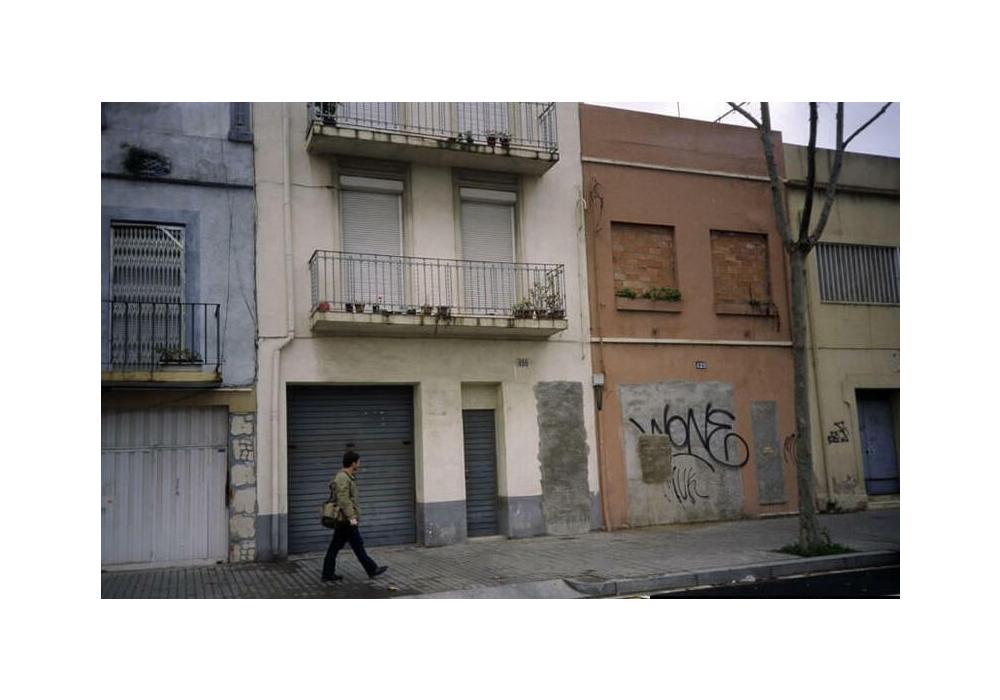
[...] Look, this is the house where that old Argentinian lady, Lucía, lives. Will her sight have improved since the operation? [...]
We walked, almost aimlessly, around this or that area of the city. We had to go round the entire city.
[...] Look, that man coming out of the cinema, isn't that Antonio? How will his business be going? [...]
We talked to strangers, sometimes with acquaintances and drew up, over the space of a year, what, little by little, we later agreed to call a contemporary portrait of the city.
[...] Those two walking hand in hand are Jacinto and Victoria, look, they're waving. And that boy, what was his name? Mohamed, he wanted a mountain-bike. [...]
We go on walking...
Let us put it this way. "Deseo" was a walk, a long walk, a walk which stretched between two springs, that of the year 2000 and that of the year 2001, around the city of Barcelona. You can walk for different reasons: for exercise, nothing more, just to do the body some good, to get a breath of air… or, as in our case, to go to find something or to meet someone. "Deseo" is the story of that singular meeting and is the mark made on the landscape of the city of that encounter.
The project sprang from the shared idea of using the public space as an alternative exhibition venue to the exhibition room, the gallery or the museum, but let us make it clear from this moment on that there was never any intention of transferring these conventional art spaces to the city, to the urban space. We did not support a cosmetic strategy by which a sample, designed and invented at the museum or the gallery or the exhibition room is presented in fringe places. We did not want to use art in this conventional way which, in fact, would be to aestheticise the urban space, an ornament and which, more than an alternative, would represent a barrier preventing art from developing an effective, constructive and critical function. A barrier against the possibility of reclaiming the public space of the city as a social place where proposals could be put forward for the development of a critical culture in response to the established discourse and where expression could be linked to the community itself.
From the very beginning, "Deseo" meant a change in our way of doing things, a U-turn, a move from the studio or workshop into the street. We were, above all, experimentalists, and we needed to be incredible mobile, creatively mobile, continuously changing terrain and zone. We watched the old problem of art and life turn into the problem of art in life. And we reoriented art, our art, so that it used industrial production as a means and the advertising support for showing. An art which, having lost its autonomy, becomes linked in the creative process to other disciplines such as sociology, town planning, history, design, advertising.
The 140 different images which make up "Deseo" are dispersed around the urban landscape, using the usual platforms, even the strategies of the world of advertising. All these images which form "Deseo", whose expressive force lies in its nakedness, are in some way familiar, everyday, close to one, even improvised, instant, domestic, as if they could be put into a family album. They obey a very simple formula, "image + message", the portrait of a contemporary citizen chosen at random in the city, accompanied by one of the desires he or she expressed. These images weave a work within the space of the intervention, at once visible and invisible, in contrast to the everyday urban routine inhabited by other signs, other banners, other graphic messages and other advertisements in other windows, the frenetic, colourist advertising found in each and every street…, posters, shop windows, building fronts, hoardings, buses, television channels… the frenetic, colourist advertising found in each and every street.
There exists no shelter for contemporary men and women which equals the shelter offered by advertising. Advertising is that world apart, that other world populated by happy people, daring, seductive men, liberated women without complexes who cause a sensation wherever they go. Advertising -firstly it was nature, then the city- is now our home. No one goes shopping to the world of advertising, you go to advertising to stay, as one goes home-sweet-home. Advertising does not attempt to sell us anything, but to give us the gift of the exact co-ordinates for life. This is the prime purpose, the most important purpose of the advertising message: the organised, systematic object of imposing a specific ideology to which the individual gradually adapts until he or she loses, having first lost all awareness of reality, his or her entire critical capacity or capacity of reaction. After all, advertising is, plainly, the direct child of ideological propaganda, spread from and by a dominant class which controls not so much the means of production as the means of communication, the media, the channels for broadcasting messages, the codes and modes of decoding, and addressed to a dominated class incapable of isolating itself from this message and which ends up an accomplice of its own subjection as if it were some kind of practice of a discipline of humiliation.
Faced by such a relentless bombardment of messages and images, such visual and sound "impact" -as they call it in television speak- contemporary men and women have ended up losing the power of speech and have lost their face and have lost their body. In the midst of the stultifying oppression to which the individual is subjected all the time, everyday, freedom is a fatal illusion which denies all critical positions. Who can base his or her freedom on the possibility of choosing between different brands of sports shoes or sanitary towels or after-shave or tinned cockles in their own juice, between one television soap or another, between one weather forecast or another? Principle of freedom in our democracies? Fatal illusion? Poisoned sweets? Commercial photography, with its ceaseless praise of youth and a conventional canon of beauty, has had a decisive influence on how we see our own bodies -more than on how we should see them- and has embarked us on a frantic search for external images in which we can see ourselves reflected and recognise ourselves as one who recognises himself in the deformed image sent back time and again at a fairground Hall of Mirrors. Advertising, that contemporary space destined to create and spread the new economic power which rules the world, has turned people into consumer units who, in the final outcome, are incapable of desiring what they buy and who rather buy what they have been taught to desire.
It is amazing -an outrageous amazement- how advertising messages become superimposed one over the other, how they come one after the other at such dizzying speed in this new contemporary Babel, destroying language in its best, most immediate expression: conversation, the exchange of words and speeches. Language is nothing more now than simple communication, words merely name, they no longer have meaning, speech is no longer made up of proper words but of improper, the words of others, of those in control of the codes they pass out for dissemination. We speak their words -blindly repeated, quickly spreading through the advertising media themselves¾ we are the unsuspicious incarnation of their slogans, the transmitters of their mottoes. Their adverts pollute our everyday expressions. Who has never "had a break, had a Kit-Kat", though not necessarily eating any chocolate? Who doesn't know which cleaning product "washes whiter"? Who does not know which brand of medicine to turn to when "another cold, or is it flu"? Does anyone know what these words mean? They are empty, there is no voice behind them, they are useless babble, a ceaseless, deafening noise which we seem to have decided to get used to.
Art, to return to what we were saying at the beginning, should form a conscious alternative for listening to the lost tone of our own voice and the sound of silence, which we have forgotten, a conscious possibility to recover the word and to propose the development of a constructive, effective culture of criticism and reaction, in which "artist", "engagement" and "work" are not independent of a certain social responsibility, apart from one which reaffirms truly rebelliousness of thought and deed. Though, looking at the overall panorama, there are few straws to clutch at in the present sea of artistic creation, with its proliferation of discourses "constructed" on the simplistic tendency of a "transgressive" art which becomes the art of the accumulation of "transgressions" in the same way as one might say the art of the accumulation of trivialities, or on a set of personal experiences presented, nice and easy, as inevitable mythologems, empty mythologies of the ego completely lacking in interest or value, or on the impermeable nature of political discourses reduced to pure rhetoric and self-masturbation. No, we'll get nowhere like this… nowhere at all.
Let us at least be aware of the battle we need to fight. "Deseo" is also this attempt at awareness-raising, it is not merely a route, nor is it merely an ephemeral intervention, nor just a beautiful gesture. It is the enthusiasm with which we threw ourselves into involvement with this action -ourselves, those who lent us their time, their image and their desires, those who took part in one way or another, directly or indirectly- it is the passion which has embellished each of the snapshots and each and every one of the takes, it is the feeling of having taken an active part in a specific contemporary moment, it is a cartography of desire and it is a campaign, it is the many encounters and the many walks, it is the one-year working process and it is these lines. "Deseo" is also a way of saying that art cannot be dissociated from the historic moment in which it comes into being, that it must advance parallel to events and join in the social and political battle -for there always is one- becoming an agitating art and an agitated art.
At this point, we should like to gratefully acknowledge and thank all those who gave us their time, their ears, their faces and their words. Some of them we met, like us, walking, others were looking for work, others were passing through, others begging, whilst others we sought out in their homes, in their businesses, in their work places...
It is funny how now, a year after, one walks around the city once more with a strange feeling of familiarity, recognising in different places different faces and different desires. They are still in the city, others have left now, perhaps to come back another day, it is the same city some time later.
Consol Rodríguez
Eugeni Güell
Our times have seen the relations between the artist and the city intensified to the maximum. This means that art may be a good barometer for finding out what citizens want and, even more, an instrument for making them the principal actors in spaces which they generally cannot occupy and which are often completely inaccessible to them.
This is, amongst others, the objective of "Desire", a project which also proposes that we should take art into the public place, the public space, which is also the space where public matters are put to the debate. In "Desire", art stretches out towards civic affairs, allowing 140 people to take the floor, traversing the city with their dreams and their realities.
This is the persistent idea which underlies the project, then, a project in which art, life, politics and society go hand-in-hand, revealing the agreements and the differences they generate.
What we have always called the artist's engagement takes on one of its most noble purposes here, that of making major players of those who usually are not, and to make visible those who generally are not or who simply form part of cold statistics.
This is, then, in all its magnitude, civic art, that is to say, art in which the main actors are the city and its inhabitants.
Joan Clos
Mayor of Barcelona
DESIRE
This time, the latest proposal presented by La Virreina Exposicions at La Capella, a centre devoted to promoting the work of emerging artists, urges us to leave the exhibition room and walk around the streets of the city, where we shall find the real exhibition space of "Desire".
Under the guidance of Consol Rodríguez and Eugeni Güell, "Desire" suggests a new urban geography, a plan of the city with 140 new points of interest in which art and city, artists and citizens become merged in a single presence, each becoming at the same time both actor and spectator.
The purpose of La Virreina Exposicions, to explore the direct relations between the artist and society, is accomplished here in a two-fold way: the social environment, the urban fabric, ceases to be merely a conditioning factor to become the scene and authentic protagonist of artistic creation, whilst the artist is present not only as creator, but also as spectator and witness to this urban reality.
Ferran Mascarell
Councillor for Culture